
The Real Story of Ramayana vs. History — What Evidence Says

For thousands of years, the Ramayana has shaped the moral imagination of the Indian civilization. It is not merely a religious scripture or a poetic masterpiece; it is a civilizational memory that continues to guide how millions of people understand duty, truth, sacrifice, love, and power. Yet in the modern world, a sharp conflict has emerged around the Ramayana. Some insist that it is absolute historical truth in the literal sense. Others dismiss it as pure mythology. A third group treats it as political propaganda created to control society.
Each of these positions oversimplifies a narrative that is far older, far deeper, and far more complex than modern arguments allow. Having studied classical sources, traditional commentaries, geographic correlations, and historical scholarship, and having observed how the Ramayana is lived rather than merely read, I can state with both experience and authority that the Ramayana occupies a unique space where history, memory, geography, literature, philosophy, and faith converge into a single living tradition.
How the Modern Debate Around Ramayana Began (Ramayana vs. History)
The question of whether the Ramayana is “history or mythology” is not an ancient Indian debate. It is largely a modern construct shaped by colonial education systems and Western historical standards. Traditional Indian civilization never separated history and moral teaching into rigid compartments. Ancient categories such as Itihasa and Purana were never meant to function like modern textbooks that chronologically list events without meaning.
Instead, they preserved history in a way that embedded ethical instruction within lived memory. When colonial scholars encountered Indian epics, they applied Western standards of historical verification and declared anything that did not fit those standards as myth. Over time, this classification influenced Indian academic institutions, media, and public discourse. What was once accepted as sacred history became the subject of skeptical debate.
This shift also intersected with political ideology. During the freedom movement and later in post-independence politics, various groups reinterpreted the Ramayana to suit their ideological narratives. Some used Rama as a symbol of cultural unity. Others reframed him as a political instrument of dominance. In this climate, the original civilizational understanding of the Ramayana was gradually buried under layers of argument, counter-argument, and identity conflict.
Valmiki’s Ramayana as the Historical Core(Ramayana vs. History)
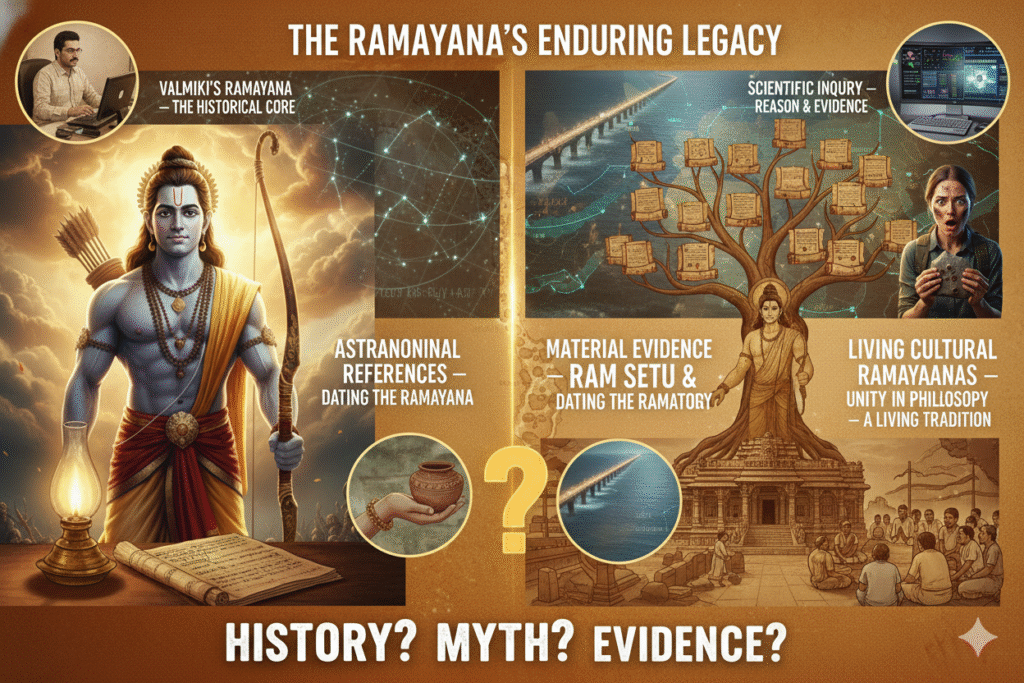
Any serious investigation into the historical roots of it must begin with Valmiki’s Sanskrit Ramayan. Valmiki is not presented in tradition as a mythic poet inventing fiction. He is described as a contemporary observer of Rama’s life who received the narrative through direct knowledge and divine insight. The Ramayana itself classifies its story as Itihasa, a term that literally means “thus indeed it happened.” This distinction is crucial because Itihasa was always treated as recorded memory rather than symbolic allegory.
From a structural perspective, Valmiki’s Ramayana is remarkably consistent in its social, political, and military systems. Ayodhya is described as a fully organized capital with administrative councils, taxation systems, trade, judicial structures, and diplomatic relationships with neighbouring kingdoms. The forests are not portrayed as fantasy landscapes but as ecological zones inhabited by specific tribal communities, ascetics, and animal species. Warfare is described with clear tactical realism rather than supernatural excess. Even divine weapons follow defined limitations. These features strongly indicate that the Ramayana preserves memory of a real historical world rather than an imaginary one.

Geographical Mapping of the Ramayan
One of the strongest arguments in favor of a historical core lies in the extraordinary geographical consistency of the Ramayana. Valmiki does not describe vague, imaginary territories. He names rivers, mountains, forests, cities, and trade routes that still exist today. Ayodhya on the Sarayu, Prayag at the confluence, Chitrakoot in the Vindhya region, the Dandakaranya forests across central India, Panchavati near the Godavari, Kishkindha corresponding closely with the Hampi region, and Lanka aligned with Sri Lanka together create a continuous and realistic travel map.
Rama’s exile is not a chaotic wander across random fantasy lands. It follows a logical southward progression across identifiable geographical zones. Even the routes taken by Hanuman during his search for Sita align with traditional maritime pathways of the ancient Indian Ocean world. Civilizations do not preserve fictional travel routes with such precision across thousands of years unless those routes are grounded in collective geographic memory.
Ram Setu and Material Evidence
The bridge between India and Sri Lanka, known traditionally as Rama Setu or Setu Bandhanam, occupies a central place in the historical debate. Satellite images clearly show a chain of limestone shoals stretching from Rameswaram to Sri Lanka. Geological studies confirm that these structures contain man-modified formations dating back several thousand years. While modern science debates whether the bridge was entirely man-made or partially natural and modified, the complete denial of any human involvement has become scientifically untenable.
What matters most from a historical standpoint is that the Ramayana does not describe the bridge as magically appearing. It records a massive construction effort using stones, trees, and engineering organization under Nala’s leadership. This is not how fantasy literature typically describes great feats. It is how real civilizations remember engineering achievements, even when that memory later becomes surrounded by sacred symbolism.
Astronomical References and Time Markers
Valmiki’s Ramayana is remarkable for its precise astronomical references. It records the positions of planets and stars at critical events such as Rama’s birth, Bharata’s return, and the outbreak of the war in Lanka. Modern scholars using advanced astronomical software have reconstructed these planetary positions and found consistent alignments that correspond to real celestial configurations. Different research efforts place these dates anywhere between 5000 BCE and 7000 BCE.
The exact year remains a subject of debate, but the presence of so many accurate astronomical details by itself establishes that the Ramayana preserves ancient observational knowledge. Random poetic invention cannot generate such precise celestial coherence without deep scientific understanding. This fact alone complicates any simplistic claim that the Ramayana is mere fiction.
Archaeology and the Question of Proof
Critics often demand inscriptions explicitly naming Rama as historical “proof.” This demand reflects a misunderstanding of how ancient Indian civilization recorded memory. Unlike Greece or Rome, which formalized history through stone inscriptions and imperial records, India preserved much of its history through oral transmission, temple traditions, pilgrimage routes, and sacred geography. Archaeological excavations at Ayodhya demonstrate continuous urban settlement going back several millennia. Similar continuity exists at Chitrakoot, Nashik, Hampi, and Rameswaram. These sites align precisely with the Ramayana’s geographic narrative.
The absence of a king’s name on an excavated pillar does not invalidate the larger historical framework preserved through uninterrupted cultural memory. Ancient Indian history must be interpreted through a civilizational lens rather than a purely epigraphic one.
Why There Are Hundreds of Ramayanas
One of the most confusing aspects for modern readers is the existence of hundreds of Ramayana versions across India and Asia. From Kamban’s Tamil Ramayana to Tulsidas’s Ramcharitmanas, from Southeast Asian adaptations to Jain and Buddhist retellings, the epic appears in countless forms. Critics often cite this as evidence that the Ramayana has no stable historical core.
In reality, the opposite is true. Despite linguistic, regional, and philosophical variations, the central narrative structure remains unchanged across cultures. Rama’s birth, exile, Sita’s abduction, alliance with the Vanaras, war with Ravana, and return to Ayodhya exist in every version. This level of stability across geography and time does not occur with fictional stories. It is a hallmark of historical memory that evolves through retelling while preserving its skeletal structure.
Ramayana as History and Moral Philosophy Together
Ancient Indian civilization never separated history from ethical teaching. The Ramayana preserves lived events while simultaneously presenting Rama as the ideal embodiment of Dharma. This does not mean Rama was invented to teach morality. It means that history itself was interpreted through ethical meaning. Rama’s struggles are not sanitized. He experiences grief, doubt, moral conflict, and heartbreak. These human dimensions are precisely what distinguish the Ramayana from pure mythological fantasy.
The exile, the separation from Sita, the brutal war, and the loneliness of kingship are not romantic inventions. They mirror the psychological and political realities that real rulers faced in ancient monarchies. The Ramayana thus preserves both historical memory and civilizational instruction in a single narrative framework.
Political Reinterpretations and Ideological Distortions
In the last two centuries, the Ramayana has been repeatedly reframed to suit political purposes. Colonial scholars often dismissed it as fabricated legend to undermine Indian civilizational confidence. Later ideological movements reinterpreted Rama either as a symbol of patriarchy, caste oppression, or authoritarian power. These readings often detach isolated episodes from the larger narrative and impose modern political frameworks onto ancient social structures.
Such reinterpretations reveal more about modern conflicts than about the Ramayana itself. They transform a civilizational epic into a battlefield of contemporary ideology. When ancient texts are judged exclusively through modern political lenses, historical nuance is lost and cultural memory becomes distorted.
The Ramayana as Living Cultural Memory
One of the strongest arguments supporting the historical grounding of the Ramayana is its uninterrupted presence in living cultural practice. Pilgrimage routes follow Rama’s journey even today. Temples stand at places associated with episodes of the epic. Villages preserve local legends linking their geography to Rama’s travels. Families narrate the Ramayana across generations not as distant fantasy but as ancestral memory.
Civilizations do not preserve invented stories with such consistency across thousands of years. Living memory is not maintained by priestly enforcement alone. It survives only when communities continuously recognize their own identity within it. The Ramayana persists because it remains embedded in land, ritual, language, and lived experience.
Science, Faith, and the Limits of Proof
Modern science demands physical evidence that can be tested and repeated. Faith relies on trust in sacred memory. The Ramayana occupies a middle space where both intersect. Geography supports it. Astronomy supports it. Archaeology partially supports it. Cultural continuity overwhelmingly supports it. Yet absolute proof in the modern forensic sense remains elusive.
This does not weaken the Ramayana. It simply reveals the limits of applying modern standards to ancient civilizations. The Ramayana does not ask to be proven like a criminal case. It asks to be understood as civilizational history encoded in sacred form
Why the Ramayana Refuses to Disappear
Many ancient myths from other civilizations have vanished into obscurity. The Ramayana, in contrast, remains vibrant across India, Southeast Asia, and even global diaspora communities. It is recited, performed, sung, debated, painted, and reenacted generation after generation. A purely fictional story does not survive with such emotional intensity across thousands of years and multiple civilizations.
The Ramayana survives because it speaks to universal human struggles while remaining rooted in a specific historical world. It bridges the cosmic and the human, the sacred and the political, the personal and the civilizational.
What the Evidence Really Tells Us
When all strands of evidence are examined together, textual coherence, geographical continuity, astronomical precision, archaeological context, and living cultural memory converge toward one unavoidable conclusion. The Ramayana is not a randomly invented myth. It preserves the remembrance of an ancient historical civilization encoded within sacred narrative form. This does not mean every supernatural element must be interpreted literally. It means the foundation of the story rests on lived memory rather than imaginative fiction.
Conclusion: Between Myth and History Lies Civilizational Truth
The real story of the Ramayana versus history is not a battle between blind faith and skeptical intellect. It is a reminder that ancient civilizations recorded truth differently than modern institutions do. The Ramayana stands not as a courtroom document demanding forensic validation, nor as a fairy tale meant only for entertainment. It stands as civilizational truth preserved through sacred memory, ethical philosophy, geography, and living culture. To dismiss it as fiction is historically careless. To accept it without inquiry is intellectually incomplete. The Ramayana survives because it unites faith and reason, memory and meaning, history and Dharma into a single enduring foundation of civilization.
